Friday, February 12, 2016

OFF (the wall)

If video games are art, OFF is probably what you would get if you handed the surrealist movement an RPG Maker kit and told them to go wild.

What exactly are we supposed to expect from this?

OFF does not waste much time on introductions. Your protagonist, a baseball player simply called "the Batter", is on a sacred mission to purify the world's Zones and defeat the specters that plague them. A perpetually-grinning cat calling itself "the Judge" gives you quick tutorials on combat and solving puzzles, and before long you'll be busting ghosts and letting the intimidated inhabitants of Zone 1 get back to their important jobs of mining smoke and extracting metal from cows. If none of that makes any sense to you, you're not alone; explanations for this game's events are few and far between, and all answers just serve to raise further questions. It's that kind of game.

The world map itself is confused.

Even before the Batter arrives on the scene, the universe of OFF is on its own the definition of bizarre. The Zones, where all the action takes place, are essentially huge metal platforms floating in a sea of liquid plastic. There are very few signs of any life in the world other than the specters and the not-quite-human residents of the Zones. (And the aforementioned cows.) There's an air of artificiality to everything, and this, combined with the fact that the world bears little to no resemblance to our own, makes the atmosphere distinctly unsettling.

It's the art direction that really supports this feeling. Graphics are mainly minimalist, flatly colored sprites, unless they decide to be hand-drawn pencil sketches, or rendered photographs. Most characters are totally monochrome, while their environments are brightly colored. The strange combinations really hammer in the constant feeling of unfamiliarity that totally permeates the world of OFF. The soundtrack also deserves mention here, being an unconventional mix of ambience, harsh noise, and the occasional jazzy swing bit. It's a shining example of how all the elements of presentation can combine to set the mood, which in this case is almost terrifyingly surreal.

Also, there's pedalos.

And as for the Batter's own journey, well! I won't go into much detail, because there's a lot of things that are better experienced first without knowing about them beforehand. However, the plot of the game is every bit as weird as the world it takes place in. Symbolism is rampant, and it's often unclear what exactly anything is referring to. There's a wide range of theories about just what is going on, especially in later parts of the game, and nothing can really be proven. The one thing that does become clear is that there are sinister forces at work in the world. OFF's genre is often classified as "surreal horror", and while much of this post focuses on the surreal aspects, it definitely does earn its horror designation. Even the Batter's motives and the consequences of his actions are thrown into question by many characters and by his own actions, yet the Batter presses onward.

Or rather, you push the Batter onward.

In my last post, I talked a good deal about the impact of a player's choices on a game designed around them. In contrast, OFF presents very few in-game decisions to the player. Certainly it's possible to take in the sights in one Zone for a while, or return to a previously purified area before continuing on to the next, but ultimately, the Batter will end up at the same destination no matter what path you choose for him to get there. Yet this, too, is a way to look at the player's ability to choose. As is eventually revealed, even if there seems to be no other way to go, there is always one decision the player can make: to quit and leave the world of OFF behind, or to keep going and fulfill the Batter's mission. And, within the game's universe, this may be the choice with the greatest impact of all.

But if you don't play, you won't get to meet this guy. Just saying.

I do have to admit, however, that there is a particular flaw in OFF that detracts a bit from the experience. For a game that is all about kicking the player's expectations and knowledge about how the world works to the curb, the combat system is remarkably straightforward. Purifying specters (and the occasional whale) is done in a very stripped-down version of an RPG battle system, and the fact that your moves have such names as "Saturated Chain" and "Run with Courage" does little to hide the fact that there's little actual strategy involved. Even boss battles can often be won simply by setting the fight to "Auto" and watching the Batter smack away with his pixelated baseball bat, with occasional breaks for healing. This wouldn't be too much of a problem, if not for the high frequency of both random and forced enemy encounters that leave the Batter no choice but to fight. Perhaps it's meant to be a statement about how senseless violence is a poor solution to our problems? In this game, that's entirely possible.

This specter looks like it just told us a really bad joke.

In the end, though, boring combat isn't enough to totally ruin the brilliantly bizarre atmosphere that OFF sets up. In some ways it even improves the experience, by encouraging normal RPG players to pay attention to the world and the story unfolding around them when they would otherwise be hacking through as many foes as possible. And OFF's worldbuilding and story are practically perfect, if often incomprehensible. Its greatest strengths lie in its ability to draw players into its wacky world, make them believe that the weirdness is entirely plausible, and then, when things get bad, remind them that they always had the chance to leave if they really wanted to. So, when you finish your homework and are looking to be transported to a whole new world, give OFF a try. You might not regret it.

Thursday, February 4, 2016

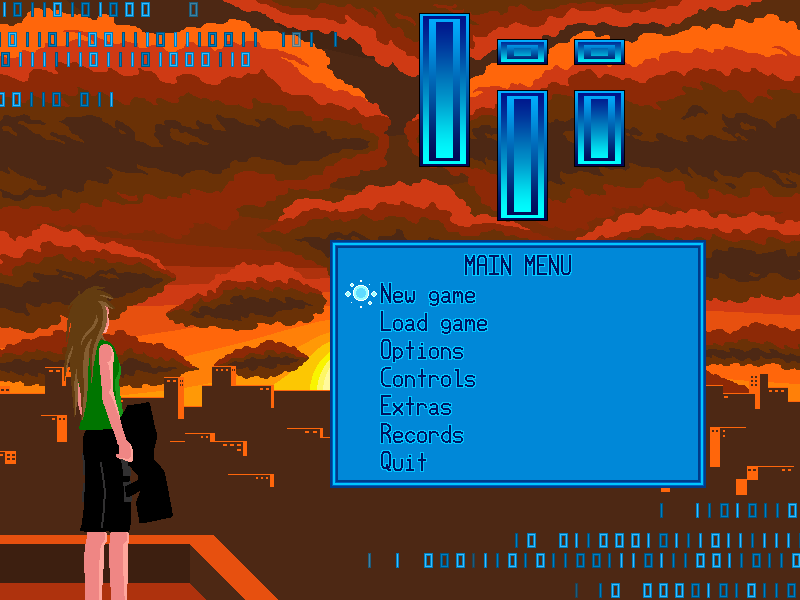
Iji (Fighting Aliens and Other Questionable Decisions)

If you liked freely blasting your enemies to bits in Cave Story, Iji is going to be a fun and interesting experience for you.

A young girl stares at her own name projected in the sky.

Iji is just an ordinary girl, taking an ordinary trip with her ordinary family to the ordinary research facility where her ordinary dad works, when she looks out the window and sees some definitely-not-ordinary lights in the sky. The next thing she knows, she's laying in a bed, and the bodies of several researchers are laying right outside the door. As her brother Dan explains over the facility's speaker system, the lights came from aliens called Tasen who struck the building with a barrage of lasers before descending into the facility and killing everyone they could find. However, all hope is not lost, as the survivors have spent the last six months(!) using Tasen nanofield technology to turn Iji into a weapon capable of standing against the invaders, able to use Tasen weaponry, upgrade abilities, take machine gun fire to the face, survive long falls, crack codes, and basically do anything a video game protagonist would need to do. Now, Iji is the last hope for the humans against the Tasen invading force.

And all that before you even get to the controls.

So begins the tale of Iji's fight against the Tasen. Gameplay-wise, the game is essentially based around shooting aliens and trying not to get shot by them in turn. The research facility setting, while full of branching corridors to explore, is not exactly conducive to jumping around and falling into pits, so instead, Iji gets its difficulty from constantly thrusting its heroine into combat.

A fairly standard situation for Iji.

Enemies get stronger and more numerous as the game progresses, and Iji too gets stronger as she gains more experience in fighting. Killed aliens drop nano fields, which can be picked up to increase stats and gain the ability to wield rocket launchers, machine guns, and ever more powerful guns. From beginning to end, Iji is a constant battle against merciless foes, and Iji guns them all down, because that is the only way that she can save the last vestiges of humanity.


...or is it?


Near the beginning of the first level, Iji encounters her first opponent, the lowliest of Tasen foot soldiers. Dan's advice says that while she should kill the enemy in order to grow stronger and get used to fighting, there is nothing stopping her from simply walking past. Some players might not even notice this line before they open fire and clear the path; after all, the alien has no qualms about attacking the moment it sees Iji. In truth, this is a choice that will be repeated throughout the game. Iji herself expresses doubt about killing Tasen, and while players used to other games may not think twice about mowing down a hallway filled with alien soldiers, sparing their lives is always an available choice.

And ultimately, it is choices that define Iji's journey. The game does a brilliant job of handling the player's choices and reacting to them. As stated before, the most commonly recurring choice throughout the game is whether or not to kill. It is in fact possible to complete the entire game without taking a single life, and without going into too many plot details, this does have an effect on how the story plays out. Both pacifism and murder are viable solutions here, and Iji, Dan, and the rest have their own opinions on how the situation should best be handled, but it comes down to the player to guide Iji down their chosen path. And, by the end, the player will have to decide whether they really made the "right" choice.

Dan would rather not think about things like that.

Player choices extend beyond the simple "fight-or-flight" of combat. Head down this hallway, or take that elevator? Upgrade health to take more hits, or upgrade weapons to deal out more damage to enemies? Use a valuable item now, or save it for later? All of these choices can end up changing not only the player's experience of the gameplay but how the characters themselves experience events, and many actions, even ones as minor as ignoring a single logbook, will be commented on by the characters. The result is a game where every action the player takes feels important.

What begins as an ordinary sci-fi gunfest quickly blooms into something surprisingly deep. Everyone, whether human or alien, generally avoids being one-dimensional or stereotypical, and their actions and reactions make sense; Iji herself in particular reacts just about as well as you would expect to suddenly having all the hopes of humanity riding on her. Surprisingly for a game with such a bleak premise, there's a good amount of humor as well, as Tasen logbooks complain about everything from the weather to the pests to the guns that only their higher-ups are allowed to have. There's a terrific attention to detail as well, and while the game only takes two or three hours to play all the way through once, bonus features, difficulty levels, and loads of secrets keep things fresh even when replayed.

One of the advantages of video games as a medium is that they give players the power to make choices that affect how things turn out, and Iji is possibly one of the greatest examples of how the element of choice can be used to make an impact on players. When your homework's done and you're looking for a game with an excellent story, playing Iji is definitely a good decision.

Thursday, January 28, 2016

Cave Story (It's Aptly Named)

When deciding what to write about for my passion blog this semester, I settled on video games as a topic pretty quickly. They've always been an important and often overlooked form of media to me. However, as I sat down to write, I realized that it would be difficult to convey my feelings to other people; after all, it's a commonly held belief that video games are stupid, and I wholeheartedly agree. In order to properly discuss video games that I love with people who don't care, I need to figure out: why do I care so strongly about games?

To answer this question, I first looked to Cave Story.

There's stories in them there caves.

Cave Story is a free platformer game by Daisuke "Pixel" Amaya, who programmed, wrote, drew, and composed the entire thing by himself over the course of five years, which is a pretty impressive feat considering that it takes me hours just to write a simple blog post. His original description of the game upon its release in 2004 is as follows: 

Cave Story is a jumping-and-shooting action game. Explore the caves until you reach the ending. You can also save your game and continue from where you left off.

It turns out there's a little more to it than that.

After a short, unexplained cutscene, we're introduced to our similarly short and unexplained hero, pictured above in the cave where he begins the game. Leaving this cave reveals another, slightly larger cave, populated by strange critters and obstacles. By proceeding further into the cave, the hero can get a gun, which allows him to fight the monsters and clear away the obstacles. Then he can get through a door leading into another cave, from which more caves branch out, which allow access to other caves, and let's just say that there's a few very good reasons they call this game Cave Story.

One thing I've always liked about this opening sequence is its total lack of "tutorial" elements. There's nobody to walk our hero through his first jumps and deadly spikes, nobody to tell him what the deal is with this gun he found in the middle of a cave. The game doesn't even make the controls clear, although they're not hard to figure out. You're just thrown into this situation with no knowledge of what's led up to this, and as it turns out, your character is in the same boat. While it may be initially confusing, this helps to build a sense of immersion, that "you are your character", and this feeling is what drives the impact of the story that unfolds from this point.

You may have been wondering where the "story" part of Cave Story comes into play. As this blog runs, I will be talking about the varied and sometimes unexpectedly deep plots of games, and how their story elements make them worth playing. Cave Story's plot, for its part, is relatively straightforward. After making your way out of the first cave, you find a town populated by little bunny people who live in the caves for...some reason. You're introduced to a few key characters and the villains who make their lives miserable, and soon enough you're in the caves again, on your own against the machinations of the mysterious yet definitely evil Doctor.

None of these people are the Doctor.

It's a simple, "video-gamey" plot, which is mainly made to give some excuse to the various caves and creatures that inhabit it, and to give the player a bad guy to shoot at. Which is why the game's emotional moments often come as a shock. Characters can and will get hurt, even die, and the game has ways of making the player feel the impact of their loss, whether it's taking up a powerful weapon from a dying warrior or realizing, while just on the threshold of the final boss's lair, that a tragedy long since gone could have been averted. By the end of the game, the characters you met in the caves seem to reach almost human levels of motivation and compassion, and by this point you're playing to make them happy and give their sacrifices meaning as much as you're playing just to "reach the ending". 

Ultimately, however, every element of Cave Story, from its surprisingly heartfelt narrative to the cute, pixelly graphics and retro soundtrack, serves to enhance gameplay. After all, when you play a game, you generally want to have fun, and Cave Story delivers fun in spades. While the story's out of focus, each level is really enjoyable to blast your way through. There's a variety of weapons, and while all of them have their uses, it's entirely possible to just pick your favorite and start shooting. Most enemies will fall quickly in the face of your withering sea of infinite ammunition, but that's not to say that the journey will be easy. Skillful jumping is often needed to get through perilous situations, and bosses are usually much tougher than the levels that precede them.

Fun fact: This frog killed me. Several times.

Outside certain boss sequences, though, there's really not a whole lot of thought you need to put into playing Cave Story. Just jump the gaps, fetch the items, fire your guns as fast as you can, and enjoy the story that's being told.

Cave Story was one of the first games that I really loved, and looking back on it it's not hard to see why. Even if it lacks a whole lot of depth, it makes up for that by just being fun, in both its caves and its story. If you're looking for a fun game, and you've finished your homework, I absolutely recommend downloading Cave Story.